How to Get More Bookings From Your Salon Website (Local SEO for Salons)
Local SEO for hair salons comes down to one thing: being the obvious answer when someone nearby searches. Someone types “hair salon near me” or “balayage in [your town],” and you want to be the name that shows up, looks legitimate, and makes booking one tap away — not the name three results down with a stalled website and two reviews from 2019.
That's built from three things working together: a Google Business Profile that's actually filled in, a website fast and clear enough to convert the click, and reviews that make a stranger trust you before they've met you. Most salons have one of the three half-done, then wonder why bookings from search have stalled.
I build these systems for UK hair and beauty salons on Squarespace — this is the version of local SEO I'd actually tell a client to spend time on, not the vague “boost your visibility” version some agencies sell.
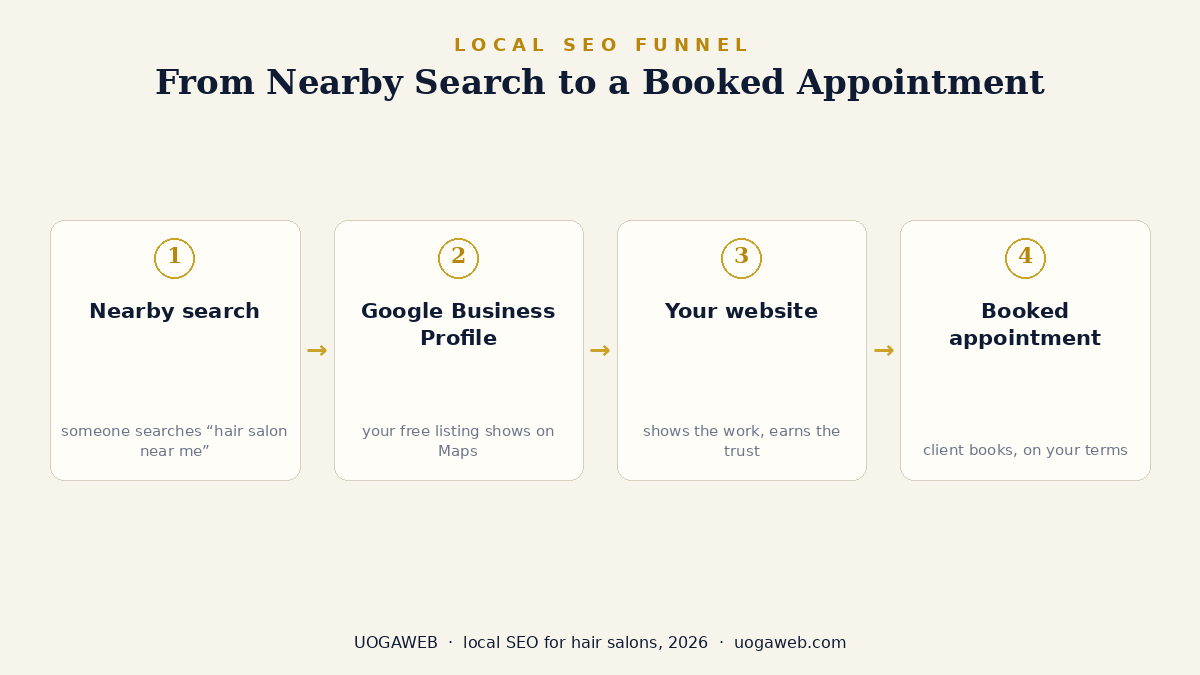
How do you rank higher on Google Maps?
Distance from the person searching matters more than most salons want to hear — you can't out-SEO being three miles further away when someone searches “near me.” What you can control is the rest of it: how well your profile and site match what they typed, and how established you look once they click through. A profile with the right category, real photos and forty reviews beats a thinner one two streets closer, more often than owners expect.
“I'm not ranking on Maps” is almost never one fix — usually a vague category, a profile nobody's touched in months, or a review count that hasn't moved in a year. Fix the profile first. It's free, and it moves fastest.
Is a Google Business Profile enough on its own?
No — and this trips up a lot of owners, because a Business Profile costs nothing and looks like plenty on its own. It's the front door: how you show up in Maps and “near me” searches, genuinely essential, set one up today if you haven't. But it can't hold your full price list, tell your story, or decide where a “Book now” tap actually lands.
The strongest setup sends the two working together: a complete, active profile feeding a website you own. Google gets someone to your name; the site turns that into an appointment in the book. Skip the site and you're relying on people calling a number off a Maps listing — fewer do that than you'd want.
If you're still deciding whether a website is worth it before any of this, I wrote the fuller case here: do you actually need a website for your hair salon.
Setting up your Google Business Profile properly
This is the free part, and it's where I'd start regardless of budget.
What categories and services should you list?
Pick whatever completes “this business is a…” rather than “this business has a…” — Hair Salon, not Salon-and-Spa-and-Everything. You get one primary category and up to nine additional ones; use the primary for what you actually are. Then list your real services, from Google's suggested list or your own, with prices if you're comfortable.
Photos and Posts: what's actually worth doing
Photos: JPG or PNG, 10KB to 5MB, at least 720×720px, per Google's spec — but the bar that matters is honesty. Your actual chair, your actual work, updated every few months; a five-year-old, stock-feeling set reads as closed even when you're not. Posts: up to 1,500 characters with a photo and a button, shown right on your listing. Useful for an offer or new stylist; a dead feed abandoned after two posts does more harm than none.
Where should the booking link point?
Once verified, add your own booking URL manually under the profile's Bookings section — no third party required. Point it at a page you own, not a marketplace listing. It costs the same either way: Fresha, Booksy and Treatwell only charge on a brand-new client their marketplace hands you, never on one through your own button — but the relationship still sits with whoever owns the page. More on that decision here: the best booking system for a salon website.
On-site local signals your website should carry
Your homepage title and H1 should say what you are and where, plainly — “Hair Salon in Leeds” beats a clever tagline with no service or location word in it. Save the cleverness for the line underneath. The rest of the on-page work is the same on any Squarespace site — I’ve covered it step by step in the Squarespace SEO checklist.
Do you need a separate page for every service or town?
Sometimes, not always — this is where salons hurt themselves. One proper page for a genuinely distinct, high-value service, bridal hair, a signature colour technique, can be worth building and can rank on its own. Ten thin pages that each say the same three sentences with a different town swapped in are spam, and can drag the rest of the site down with them. Can't write four honest paragraphs that don't just repeat the homepage? Don't build the page.
What is NAP consistency, and does it actually matter?
NAP is your Name, Address and Phone — it should read identically everywhere: website footer, Business Profile, Facebook, any directory. “12 High St” on one and “12 High Street” on another looks trivial to you and confusing to whatever's trying to confirm you're one real business in one real place. A five-minute audit, worth doing once a year.
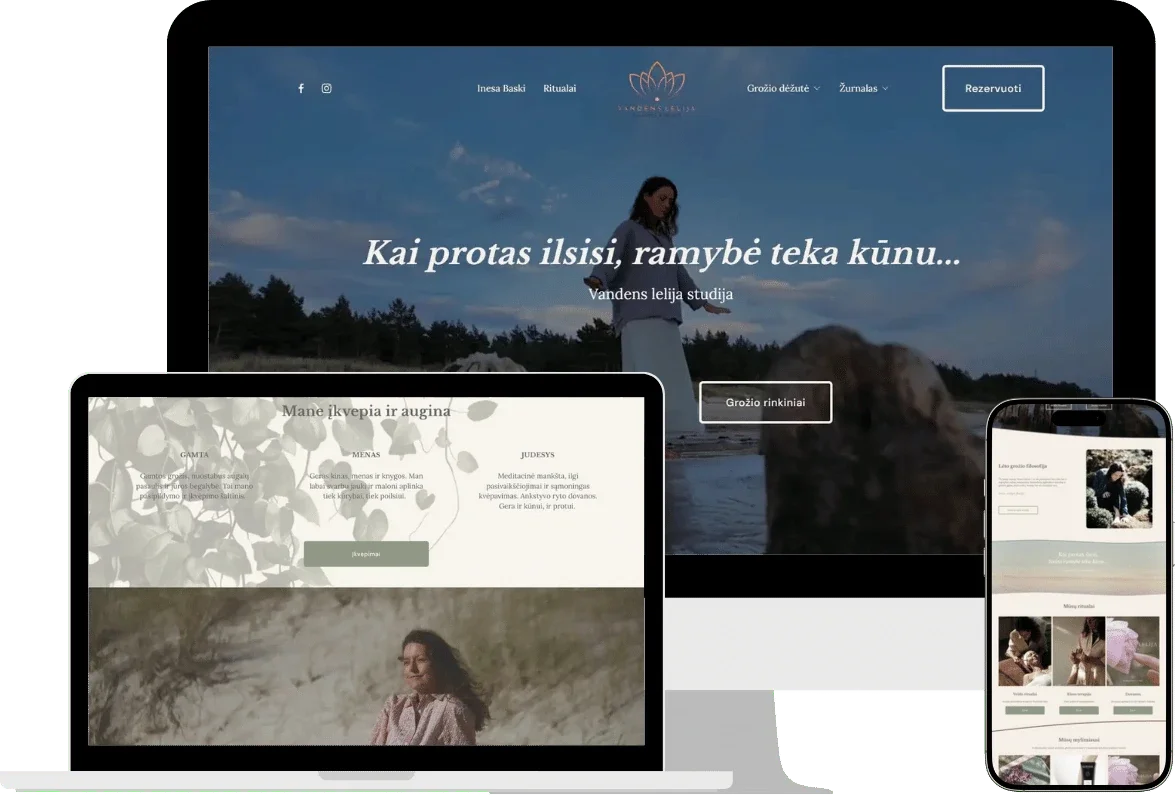
Here's a live example built with exactly this in mind — clear services, a real location, nothing thin about it: Vandens lelija studija.
Reviews: the one signal you can't fake your way past
How do you actually get more reviews?
Ask every client right after the appointment, while the result is still the best advert you have. A same-day text or email with a direct link beats a sign by the till nobody reads on the way out.
Should you respond to bad reviews?
Yes, every time. On a verified profile you can reply directly, and Google checks the reply against its content policies before it goes live, usually quickly. A short, human reply — no defensiveness, just what you'll actually do — reassures the next reader more than the review itself does.
What I won't tell a client to do is buy reviews or run a “five stars for 10% off” scheme — against the platforms' rules, obvious to anyone reading closely, and the research backs up why it matters anyway: BrightLocal's 2026 Local Consumer Review Survey puts the share of consumers who read online reviews for local businesses at around 87%.
What keywords should a salon actually target?
Forget generic terms like “hairdresser” — every salon in the country fights over those, and you don't need the whole country, just the three miles around your chair. What works is service plus place: “balayage in [your town],” “wedding hair near [your area],” “men's barber [your town].” Specific enough to match how a real person actually searches, and specific enough that you can genuinely rank for it instead of watching a national chain outspend you on the generic version.
Write these into actual page content — service pages, the homepage, an FAQ — not stuffed into a sentence unnaturally. One well-written paragraph that happens to include “balayage in Leeds” beats the phrase repeated five times across a page that reads like it was written for a machine.
Removing the friction between a search and a booking
None of the above matters if the click doesn't turn into a booking. The Book button should live in the main navigation and repeat at the bottom of every page — nobody should have to hunt for it, especially on a phone, where most salon traffic actually arrives.
Does mobile page speed really affect bookings?
Yes, and it's not subtle. A page that takes several seconds to load loses people before they've seen a single price — often on a slow connection outside a train station, exactly when they're searching. Compress images, keep the design clean rather than stacked with heavy sliders, and test the site on your phone on 4G, not office wifi.
What's not worth your money
A few things I'd steer a salon away from:
“Guaranteed #1 ranking” packages. No one can guarantee a specific position — not me, not anyone.
Bulk directory submissions. Dumping your listing into fifty low-quality directories did something a decade ago. Not now.
Rank-tracking software for one location. A monthly search from your own phone, logged in a spreadsheet, does the same job.
A full rebuild every year “for SEO.” Consistency compounds; a site steadily improved beats one torn down and restarted annually.
How long does local SEO actually take to work?
Faster than expected for some of it, slower for the rest. Tightening a half-filled Business Profile — right category, real photos, services listed — can shift your Maps position within a few weeks; it's the cheapest lever, and it moves fastest. The website and reviews side compounds more slowly. On my own builds I tell clients to expect three to six months of steady, unglamorous consistency — not a switch that flips.
Should you do this yourself, or pay someone?
Plenty of it you can do yourself. The Google Business Profile work — categories, photos, posts, asking for reviews — takes time, not money, and no salon owner needs a specialist for it. What tends to need a professional is the website itself: the structure, the page speed, service pages that are genuinely useful instead of thin, and staying consistent instead of a January burst that's forgotten by March.
That second part is most of what I build into a site from the start — covered on my salon website hub, with pricing on the services page.
Does posting on Instagram help your local SEO?
Not directly — Google isn't reading your Instagram grid as a ranking signal for Maps, whatever some captions claim. What it does is put your name in front of people who then search for you on Google, a real signal, and it's the easiest place to point a happy client toward a review while the appointment's still fresh. Keep posting because it works for its own reasons — just don't expect it to move your Maps position by itself.
So where do you actually start?
If you do nothing else this month: fill in every field on your Google Business Profile, point the booking link at your own site, and ask your next ten clients for a review the same day they leave your chair. That moves more salons than a full rebuild.
If you want a straight opinion on your salon — profile, site, or both — I offer a free, no-pressure consultation and I'll tell you honestly where the gap is. Book a free consultation here.
FAQ
How do I rank higher on Google Maps for my salon?
Fill in your Business Profile properly — right category, real photos, services listed — then keep earning reviews. Distance to the searcher matters and you can't change it, but a complete profile beats a thinner one that's closer more often than owners expect.
Is a Google Business Profile enough for local SEO on its own?
No. It's free and essential, but it can't hold your full services and prices or send someone into a booking system you control. The strongest setup is a complete profile feeding a website you own.
How do I get more reviews without being pushy?
Ask right after the appointment, while the result is fresh — a same-day text or email with a direct link works far better than a sign by the till. Reply to every review you get, briefly and like a person.
How long does local SEO take to start working?
Business Profile changes can shift your Maps position within a few weeks. The website and reviews side compounds more slowly — plan on three to six months of steady, ordinary consistency before it's clearly paying off.
Does Instagram affect my local Google ranking?
Not directly — it isn't a Maps ranking signal. It's still useful indirectly: it puts your name in front of people who then search for you on Google, and it's a natural moment to prompt a review.
Gediminas Vengrauskas is the founder of UOGAweb, a Squarespace Circle Gold studio building websites for hair & beauty salons across the UK and Lithuania.