Do You Really Need a Website for Your Hair Salon in 2026? An Honest Take
Short answer: yes — almost certainly. In 2026, most people look a salon up online before they book, and the two places they look are Google and your website. If neither exists, you’re relying on someone remembering your Instagram handle — a fragile way to run a business you depend on.
But “yes” comes with honest edges. You don’t need an expensive site, you don’t need it this week, and there’s one genuine situation where you can skip it (I’ll get to that at the end). What almost every salon does need is a place online it actually owns — where clients see your work, check your prices, and book you directly, without a marketplace taking a cut of the new ones or an algorithm deciding who gets to see you.
I build salon websites on Squarespace, so I have a stake in the answer. I’ll keep it straight anyway — including the part where you might not need one.
Do you need a website if you already have Instagram and Facebook?
For most salons, yes — because Instagram and Facebook are shopfronts you rent, not a home you own. They’re brilliant for showing work and staying in front of regulars, and you should keep using them. The catch is that you don’t control the reach, the algorithm, or the account itself.
The problem shows up the day something breaks. A hacked or suspended account, a quiet drop in reach, a new client who can’t find your prices or a way to book at 9pm on a Sunday. When your entire storefront lives on a platform you don’t own, one bad morning can take it offline with no way to get it back.
There’s also a trust gap. Industry surveys keep finding that people research a business online before they commit — BrightLocal’s 2026 consumer survey puts the share who read online reviews for local businesses at around 87%. A polished Instagram grid helps, but a real website — with your services, prices, team and a booking button — reads as more established than a social profile alone. For a first-time client choosing between two salons, that difference is often the booking.
A website doesn’t replace social. It anchors it: social brings people in, the site is where they check you out and book. If you want the fuller version of that argument, I wrote it up here — what a salon website is actually for.
Isn’t a Google Business Profile enough on its own?
A Google Business Profile is essential — set it up today if you haven’t — but it’s the front door, not the house. It’s how people find you in Maps and “hair salon near me” searches, and it carries your reviews, hours and photos. What it can’t do is tell your full story, show your price list properly, or send someone straight into your own booking system.
It also isn’t really yours. Google owns the profile, decides what shows, and can suspend it. I’ve seen salons lose visibility overnight when their listing got flagged for a reason no one could explain.
The strongest setup is both, working together: a complete Google Business Profile that feeds a website you own. Google sends the searcher; your site converts them and books them. One without the other leaves money on the table. And once both exist, here’s how to turn local searches into actual bookings.
Do you still need a website if you use Fresha, Treatwell or Booksy?
This is the question I get most, and the honest answer is: the booking apps are useful, but they’re not a substitute for a site you own. Here’s the distinction most people miss — the marketplaces don’t take a cut of every booking. Bookings made through your own link or button are free. What they charge for is the new clients their marketplace sends you.
Fresha stopped being free in 2025 and now runs on a paid subscription; on top of that it charges roughly a 20% one-time fee when its marketplace introduces a brand-new client. Treatwell has published a rate of 35% on a new customer’s first booking — about 42% once you add UK VAT — though repeat visits are free. The FAQ on Treatwell’s pricing page states that 35%, while its plan cards say only that the commission is “subject to location”, so check your own contract. Booksy’s optional Boost tool takes 30% of a new client’s first visit. Clients you already have, and clients you bring in yourself, don’t trigger those fees.
But the fee isn’t even the real cost. On a marketplace, the new client, the discovery and the rebooking prompt belong to the platform. Your own website flips that — the client finds you directly, books directly, and stays yours. I’ve broken the numbers down in full here: what salons actually lose to Fresha and Treatwell. Keep the apps if they work for you; just don’t let them be the only thing that owns your clients.
What a website does that Instagram and a marketplace can’t
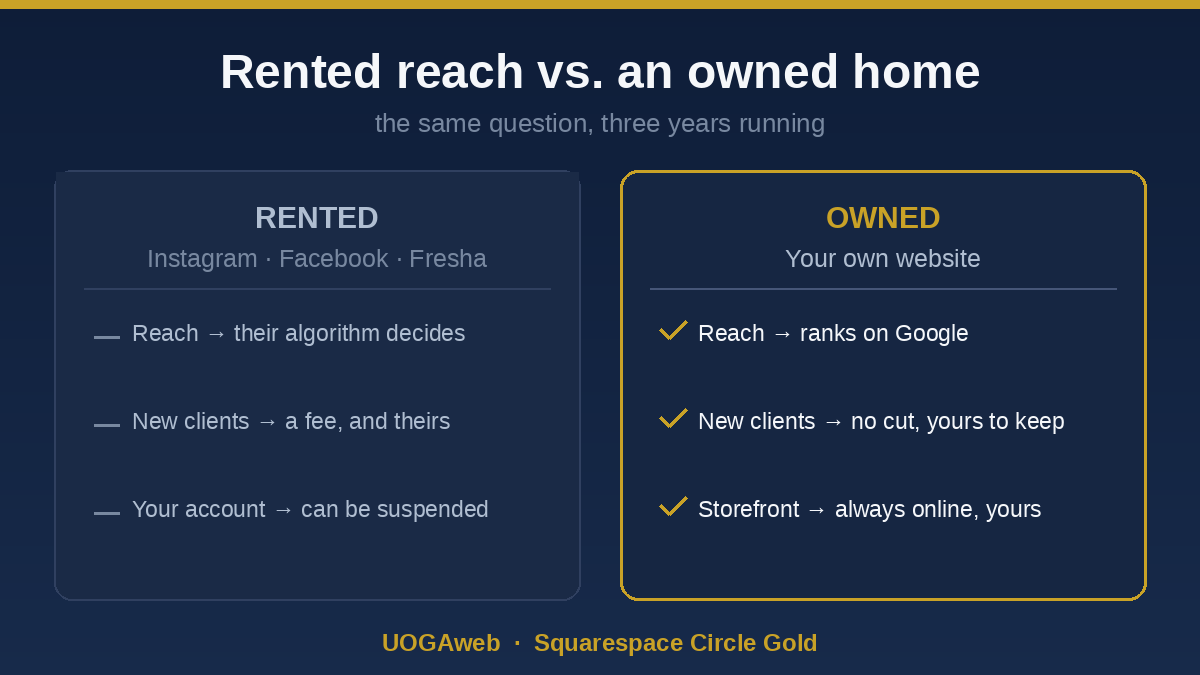
Three things, and they’re the three that compound over time.
It owns your audience. The clients who find and book you through your own site are yours — no cut on the new ones, no algorithm between you and them, no account that can be suspended.
It gets you found on your terms. A proper site can rank in Google for “balayage in [your town]” or “wedding hair near me” and pull in searches Instagram never touches. That’s traffic you don’t pay a marketplace to rent back.
And it sells the work that’s worth the most. A grid of photos is hard to price against; a real site can present your colour corrections, extensions or bridal packages with the detail — and the confidence — that justifies a higher rate. The higher-value client usually wants to read before they book.
Do clients actually look at salon websites in 2026?
Yes — just not always in the order you’d expect. Plenty of clients discover you on Instagram or a friend’s recommendation, then go straight to Google to check you out before booking. Your website (and your reviews) is the check-you-out step. No site, or a broken one, and that check quietly ends in the competitor who has a clean one.
The behaviour is strongest for anything considered — a first visit, a big colour change, a wedding. Nobody books a £180 colour correction from a single Instagram post; they read first. If there’s nowhere to read, you’ve lost the exact clients worth the most.
What about a Linktree or link-in-bio — isn’t that the same thing?
Not quite. A link-in-bio tool is a signpost, not a shop. It’s a tidy list of links, which is genuinely handy in an Instagram bio — but it’s still rented, it doesn’t rank in Google, and it can’t hold your services, prices, story and booking in one place that feels like you.
Use one if it helps people get around. Just don’t mistake it for the destination. The destination is the page you own.
How much does a salon website cost — and is it worth it for a small salon?
Less than most owners fear, and it’s the part people most want a real number for. A solid specialist salon site sits around £800–£1,400 depending on whether you need just a showcase, online booking, or a shop for products and vouchers. My own salon website packages are £800 for a showcase site, £1,000 with booking built in, and £1,400 for e-commerce — with a founding rate for the first salons in a new area. Ongoing costs are honest and small: Squarespace hosting plus an optional care plan (mine’s £75/month, with the first three months included), so a real running cost of a few hundred pounds a year, not a surprise.
Is it worth it for a small salon? Do the maths against the marketplace. If your own site brings in even a handful of new clients a year who’d otherwise have arrived via a marketplace — clients you now keep with no acquisition fee — it has usually paid for itself, and everything after that is margin. I put the whole picture, including total cost of ownership, in what a hair salon website costs in the UK.
Spend less than about £800 and you’re often buying a template you’ll replace within a year. Spend £3,000-plus and you’re usually paying for agency overhead, not a better website. The middle is where the value is.
What’s the minimum you actually need?
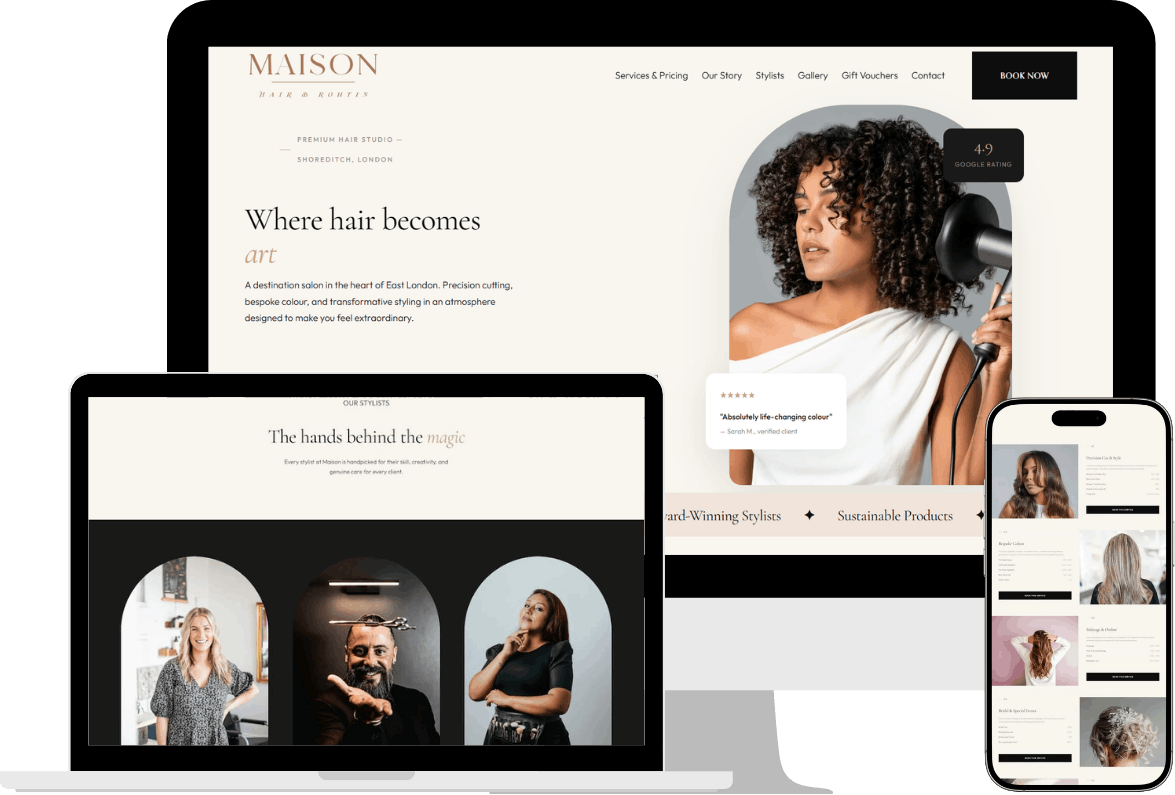
You don’t need everything on day one. If budget or time is tight, the minimum that genuinely works is three things: one strong page, a complete Google Business Profile, and your own booking link.
That one page covers who you are, your key services and prices, a few real photos of your work, your location and hours, and a clear “Book now” button that goes to booking you control. It’s fast to build, cheap to run, and you can grow it into a fuller site later — the same domain, just more pages. Starting small beats waiting for the perfect big site that never gets made.
Then it earns its keep. A clean, mobile-first page that loads fast and books people in the moment they’re interested does more for a salon than ten features nobody uses. You can see the standard I mean across my salon portfolio — real builds, not mock-ups.
When do you genuinely NOT need a website?
I said I’d be straight, so here it is. There’s one real case where a website is optional: you’re fully booked on referrals alone, you don’t want new clients, and you’re happy for that to stay true. A single-chair stylist working by word of mouth, or someone winding down toward retirement, can run perfectly well on a strong Google Business Profile and an Instagram — no site required, for now.
Even then I’d keep the Google Business Profile immaculate, because that’s where the “is this place still open?” check happens. But if you never want to grow, raise prices, or reach anyone who doesn’t already know you, you can skip the website with a clear conscience.
For everyone else — anyone who wants more of the right clients, more control, and a business that doesn’t wobble when a platform changes its mind — a site you own stops being optional. It’s the foundation the rest sits on.
So — do you need one?
If you want to grow, be found on Google, sell your higher-value work, and own your clients instead of renting them from a marketplace: yes. If you’re at capacity and staying there: honestly, maybe not yet. Most salons I talk to are in the first camp and just needed permission to start small.
If you’re weighing it up for your own salon, I offer a free, no-pressure consultation — I’ll tell you honestly whether you need a full site, a single page, or just a better Google Business Profile. Book a free consultation here.
FAQ
Do I need a website if my salon is fully booked?
If you’re at capacity on referrals and want to stay there, a strong Google Business Profile and active social may be enough for now. But “fully booked” rarely lasts forever — cancellations, a stylist leaving, a quiet season — and a website is your insurance against the day it stops being true.
Is a Google Business Profile the same as a website?
No. A Google Business Profile helps people find you in Maps and Search, but it can’t hold your full services, prices and story, or send people into a booking system you control. The strongest setup is both — a complete profile that feeds a website you own.
Can’t I just use Fresha or Treatwell instead of a website?
You can take bookings that way, and bookings through your own link are free. But the marketplaces charge for the new clients they introduce — Fresha around 20%, and Treatwell has published 35% plus VAT on a first visit, though its plan cards say only that the rate is “subject to location” — and those clients belong to the platform, not to you. A website lets you win and keep new clients directly, with no cut.
How much does a small salon website cost in the UK?
A specialist salon site typically runs £800–£1,400 depending on whether you need booking or a shop, plus a small annual running cost for hosting and optional care. One or two new clients you’d otherwise have paid a marketplace to send usually covers it.
What’s the minimum website a hair salon needs?
One well-built, mobile-first page with your services, prices, photos, location, reviews and a booking button you control — paired with a complete Google Business Profile. You can expand it into a full site later on the same domain.
Will a website actually get me more bookings?
On its own, no page guarantees bookings. But a fast, clear site that ranks locally, shows your work, and books people in the moment they’re interested removes the friction that loses first-time clients — especially for higher-value services people research before committing.
Gediminas Vengrauskas is the founder of UOGAweb, a Squarespace Circle Gold studio building websites for hair & beauty salons across the UK and Lithuania. He works with salons moving off marketplace-only and Instagram-only setups onto sites they own.