I Checked 50 Salon Websites: How Fast, Findable and Bookable They Are (2026)
On 6 November 2026 I ran the same six checks on 50 hair and beauty salon websites: 25 in London and Manchester, 25 in Vilnius and Kaunas. Every one of them had a valid HTTPS certificate. Almost none of them were fast. The median mobile performance score was 55 out of 100, only 4 of the 50 reached Google's "good" band of 90 or more, and the main image or heading took a median of 6.1 seconds to appear on a simulated mid-range phone. Just 6 sites made it inside Google's 2.5-second line.
The other basics were patchier than I expected. 72% of home page titles named the salon and its city. 72% let a visitor start an online booking in one tap from the home page. 72% showed prices as readable text somewhere on the site. 90% had a meta description. Only 19 of the 50 (38%) passed all four of those basics, and just one of those 19 was also fast.
I build salon websites for a living, so I see individual sites every week. This is the first time I've measured a batch the same way, on the same day, with the same tools. The method is at the bottom. No salon is named anywhere in this article.
What are the headline numbers?
HTTPS: 50 of 50 sites (100%) loaded over a valid certificate with no browser warning.
Mobile speed: median performance score 55/100. 4 sites scored 90+, 26 scored 50–89, 20 scored under 50.
Main content on screen (LCP): median 6.1 seconds. 6 sites (12%) were within 2.5 seconds; 35 (70%) took longer than 4 seconds; 16 took longer than 10.
Page title names the salon and the city: 36 of 50 (72%).
Meta description present: 45 of 50 (90%).
Online booking one tap from the home page: 36 of 50 (72%).
Prices visible as text on the site: 36 of 50 (72%).
All four basics at once (title, description, one-tap booking, prices): 19 of 50 (38%).
How do UK and Lithuanian salon websites compare?
The two halves of the sample were closer than I thought they'd be, and where they differed, it wasn't always in the direction people assume.
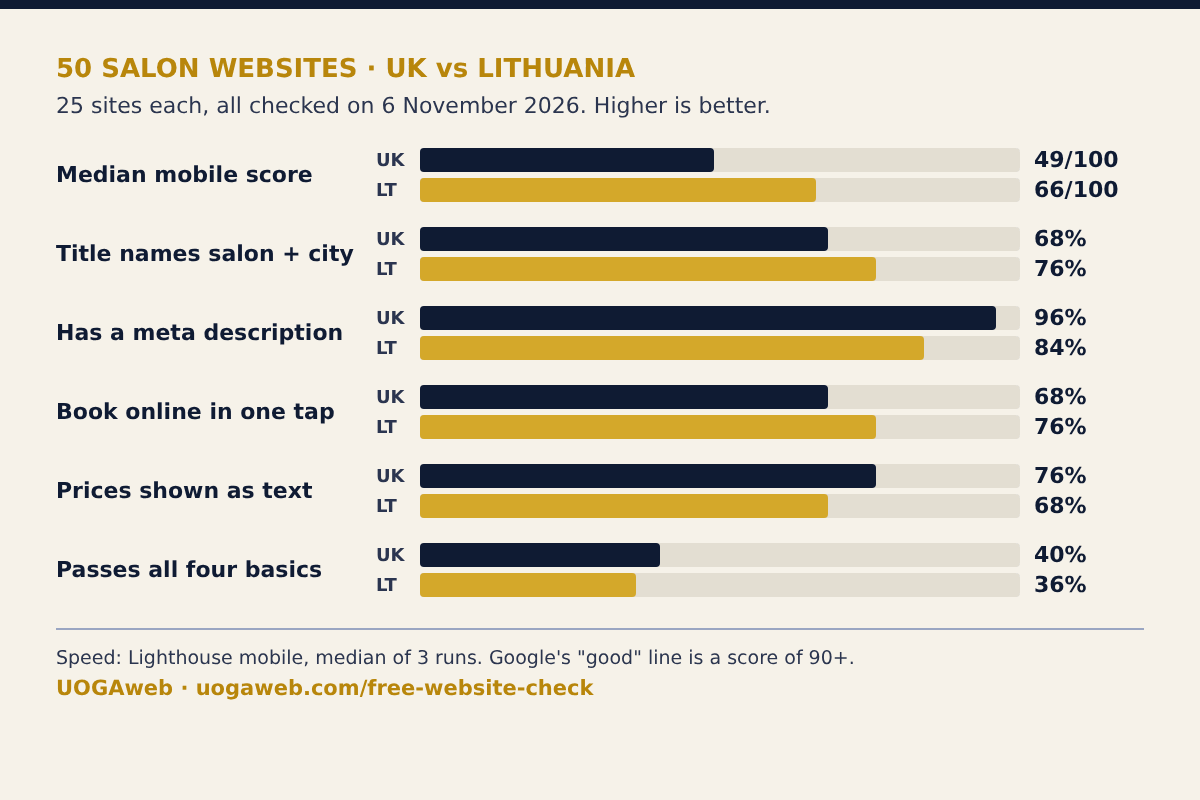
Median mobile performance score: UK 49 · Lithuania 66
Sites scoring 90 or more: UK 1 of 25 · Lithuania 3 of 25
Sites scoring under 50: UK 13 · Lithuania 7
Median time to main content (LCP): UK 8.0 s · Lithuania 5.7 s
LCP within 2.5 seconds: UK 4 · Lithuania 2
HTTPS valid: UK 25 · Lithuania 25
Title names salon and city: UK 17 (68%) · Lithuania 19 (76%)
Meta description present: UK 24 (96%) · Lithuania 21 (84%)
One-tap online booking: UK 17 (68%) · Lithuania 19 (76%)
Prices visible as text: UK 19 (76%) · Lithuania 17 (68%)
All four basics: UK 10 · Lithuania 9
The Lithuanian sites were faster on the median and better at putting the city in the title. The UK sites were better at writing a meta description and at publishing prices. Neither country was good at speed.
How fast are salon websites on a phone?
Slow. Half the sites scored 55 or less, and the gap between the median and "good" is bigger than a few tweaks can close.
The score comes from Lighthouse, the engine behind Google's PageSpeed Insights, run with its mobile settings: a simulated mid-range phone on a mobile connection. Google's own scoring bands treat 90–100 as good, 50–89 as needs improvement and 0–49 as poor. On that scale, 4 sites were good, 26 needed work and 20 were poor. The London sites had the lowest median of the four cities (45). Vilnius had the highest (71).
The 6.1-second median for Largest Contentful Paint is the number I'd pay most attention to. That's the moment the biggest thing on the screen, usually the hero photo or the headline, finishes appearing. Google says it should happen within 2.5 seconds. On these home pages, 44 of 50 missed that, and 16 took longer than 10 seconds. A client who taps your Google listing on a bus isn't going to wait that long.
What actually makes a salon website slow?
Mostly weight. The median home page in the sample downloaded 2.5 MB. Thirteen downloaded more than 5 MB, and two downloaded more than 35 MB.
The split is clear when you line the sites up by score. The 15 sites that scored 75 or more had a median page weight of 1.3 MB. The 20 sites that scored under 50 had a median of 4.7 MB, more than three times as much. Several of the slowest were built around a full-width image slider or an autoplaying background video. Those look lovely in a design preview on fast office Wi-Fi. On a phone they're the reason the page sits half-loaded.
I didn't find a platform that was reliably fast or slow. WordPress was the most common (22 of 50 sites) and ranged from 21 to 96. The five Squarespace sites, all in the UK, scored between 32 and 51. I build on Squarespace, so I'll say it plainly: the platform doesn't make a site fast. What you put on the home page does.
Do salon websites tell Google who and where they are?
About seven in ten do. The page title is the blue headline Google tends to show in results, and for a salon the useful version is simple: what you are, where you are and your name. 36 of the 50 home page titles named both the salon and the city.
The other 14 missed in different ways. Some titles named the neighbourhood but not the city, which is fine for locals and invisible to everyone searching "hair salon Manchester". Some had the salon's name and nothing else. Some had a list of services and no name at all. One Lithuanian home page title was simply the word for "Home".
Google builds the title it shows from several sources, and your title tag is only one of them, so this isn't a guarantee. But it's the cheapest fix in this whole article. It takes two minutes in your site settings.
Do salon websites have meta descriptions, and do they matter?
45 of the 50 sites had one, so this was the best-kept basic after HTTPS. One of the 45 was just the salon's name repeated, which counts as present but does no work. The five sites without one were split four in Lithuania and one in the UK.
A meta description is a suggestion for the two lines under your title in search results. Google says it uses it when it describes the page better than text taken from the page itself. A good one (what you do, where, and one reason to choose you) gives people a reason to click. Without it, Google picks text from the page, and on a salon home page that can be a cookie notice or an opening-hours line.
How many salon websites let you book online in one tap?
36 of the 50, or 72%. I counted a site as one-tap when a button visible on the home page (not tucked inside the menu) opened a real booking flow: a booking widget, a booking system page, or the salon's own booking page where the next step is choosing a service or time.
The 14 that missed fell into a few groups. Some only had a phone number or a contact form. Some put the booking link only inside the mobile menu. Some sent the "Book" button to an in-between page that asked you to choose a studio or a stylist before showing any booking at all. A couple used request forms instead of live booking, and one in-between page warned that a booking "can take up to 48 hours". And one salon's main "Book" button sent visitors to the booking marketplace's home page rather than to the salon's own page on it.
Which systems sat behind the one-tap buttons is where the two countries really differed:
Lithuania (19 sites): Treatwell 10, the salon's own or a local system 6, Setmore 2, Bookitnow 1.
UK (17 sites): Phorest 4, Slick 3, Fresha 2, Treatwell 2, Timely 2, other or white-label systems 4.
In Lithuania, Treatwell powered more than half of the one-tap bookings. In the UK no single system came close. If you're weighing those options, I compared the costs and trade-offs in the best booking system for a salon website.
Do salon websites show their prices?
72% do, as readable text on the home page or on a services or price page linked from it. UK sites were slightly better (19 of 25) than Lithuanian ones (17 of 25).
I counted prices only when they were on the salon's own site as text. A price list inside a booking widget run by someone else, or prices only on a PDF or image, didn't count. That's partly a measurement choice and partly a practical one: a price written as text can be read and quoted, and a photo of a price board usually can't.
In my experience, prices are one of the first things salon clients look for. When they're missing, the next stop is often a marketplace listing, where your competitors sit right next to you.
Are UK salon websites better than Lithuanian ones?
Not across the board. On speed, the Lithuanian sites came out ahead: a median score of 66 against 49, and a median time to main content of 5.7 seconds against 8.0. The UK sites had more of the slowest pages, including several built around image sliders or background video.
On the content basics it was close to a draw. Lithuania did better on city-in-title and one-tap booking, and the UK did better on meta descriptions and prices. Ten UK sites and nine Lithuanian sites passed all four basics.
With 25 sites a side, I'd treat a gap of one or two sites as noise. The speed gap is the only one I'd call real.
What should a salon owner fix first?

In the order I'd do it, based on what moved the needle in this sample:
Put your name and city in the home page title. Free, two minutes, and 14 of these 50 sites still haven't done it.
Make "Book" the most visible button on the home page, and make it open booking. Not a contact form, not a page of links. 14 sites missed this.
Publish your prices as text. Even "from" prices. A visitor who can see them doesn't need to go and compare on a marketplace.
Make the home page lighter. Swap the slider or autoplay video for one well-compressed photo. The fast sites in this study were roughly a third of the weight of the slow ones.
Write a meta description. One or two sentences: what you do, where, and one reason to book.
The first three you can usually do yourself in an afternoon. The fourth sometimes needs a rebuild of the home page. When salons come to me for that, a Showcase site is £800 and a site with online booking built in is £1,000, and both are built with these basics in place: name and city in the title, a written description, booking one tap away and prices on the page. The builds themselves are in my portfolio, and the full scope is on my Squarespace website services page. For design ideas from other salons, see 14 beautiful hair and beauty salon website examples, and the full list of what a salon site needs is in the salon website checklist.
How can I check my own salon website the same way?
You can run most of this yourself. My free website check measures how fast your site opens on a phone and how Google reads your page titles, and gives you a plain-language score in about a minute. For Lithuanian readers, the same tool is at svetainės patikra.
If you'd rather do it by hand, I walk through the manual version in how to check what Google actually sees on your website. For context on the two markets in this study, there's a UK page on salon websites and a Lithuanian one on grožio salonų svetainės.
And if you'd rather someone went through your site with you, book a free consultation. I'll tell you which of these five fixes matter for your salon, and which don't.
How was this study done?
Sample: 50 hair and beauty salon websites, 25 in the UK (13 London, 12 Manchester) and 25 in Lithuania (13 Vilnius, 12 Kaunas). Mixed independents and small groups, hair, nails, brows and barbering, on mixed platforms. Sites were picked from public web search results and local business directory listings for each city.
Exclusions: UOGAweb's own clients were excluded (a conflict of interest). Listings that turned out not to be salon websites (a classifieds page, a training school, a spa, an online shop) were replaced. So were sites that wouldn't load from the test machine or blocked automated visits: five in the UK and two in Lithuania.
Date: every site was checked on 6 November 2026, the same day for all 50.
Speed: Lighthouse 12.8 performance audit with its default mobile settings (simulated mid-range phone and mobile network), run three times per home page and the median kept. One site completed two runs instead of three. Lighthouse is the lab engine PageSpeed Insights uses; I ran it directly because the PageSpeed Insights API was rate-limited that day. Scores from your own PageSpeed Insights test may differ by a few points, as lab scores do from run to run.
HTTPS: the home page loaded over HTTPS in a standard Chromium browser with no certificate error.
Title and meta description: read from the rendered home page. "Names the salon and the city" means both the salon's name and the city (in any grammatical form) appear in the title tag; a neighbourhood alone didn't count.
One-tap booking: a button visible on the mobile home page, outside the menu, that opens a booking widget, a booking system or a booking page where the next step is picking a service or time. Booking buttons were followed to confirm where they went.
Prices: prices shown as text on the home page or on a services or price page linked from it. Prices only inside a third-party booking widget, an image or a PDF counted as no.
Limits: this is one snapshot of 50 home pages, not a census. Lab speed scores aren't the same as real-visitor data. Picking from search results and directories may tilt the sample towards salons that already invest in their websites.
The anonymised per-site data (country, city, platform, score, LCP and each yes/no) is available on request. If you'd like to cite these numbers, please link to this page.
FAQ
What is a good PageSpeed score for a salon website?
90 or more is Google's "good" band for the mobile performance score, and 50–89 is "needs improvement". In this study only 4 of 50 salon sites reached 90, so anything above 75 already puts you ahead of most salons. The more important number is how quickly your main photo or headline appears: Google's target is 2.5 seconds or less.
How many salon websites have online booking?
In this sample, 72% of salon websites let a visitor start an online booking in one tap from the home page. Of the other 14, about half had a way to book that was harder to reach: inside the menu, through a request form, or two taps deep.
Do salon websites need to show prices?
They don't have to, but 72% of the salons in this study did, and it helps. A visitor who can see prices on your own site has less reason to go and compare you on a marketplace, and text prices are something search engines and AI tools can read and quote.
Which booking system do most salons use?
It depends on the country. In the Lithuanian half of this study, Treatwell powered 10 of the 19 one-tap booking buttons. In the UK half the mix was much wider: Phorest, Slick, Fresha, Treatwell and Timely all appeared, and no single system was behind more than four sites.
Why is my salon website slow on mobile?
On the sites in this study, the clearest pattern was weight. The fast sites had a median page weight of 1.3 MB; the slow ones had 4.7 MB, and several of the slowest home pages were built around image sliders or autoplay background video. Replacing a slider or video with one well-compressed photo is usually where I'd start.